Cheese Days began in 1914 as a celebration of Swiss Heritage; it started as a small idea from some businessmen in 1914 and has grown immensely over the years. The first festival had between 3 and 4 thousand attendees, but the most recent festival in 2018 had over 100,000 attendees. It is a biannual event that happens the 3rd weekend of September on even years. Some of the things you can see at Cheese Days includes: cheesemaking, polka dances, and art show, and so much more. As much as it has grown over the years, Monroe’s Swiss heritage is still at the core of this event. One of the ways this is highlighted is through numerous music performances over the 3 day festival. I have highlighted some of these below.
I specifically chose to share this event because this is my hometown so I am very familiar with Cheese Days. It is a wonderful event that is great for our town. And although I may be familiar with Swiss music, I know it isn’t necessarily something that everyone indulges in. If you’d like to learn more about Cheese Days specifically, feel free to ask me or refer to this website. There will be a Cheese Days in 2022!
This is the official song of Cheese Days that was written in 1965 by Rudy Burkhalter; although he wrote the lyrics, the melody was a popular Swiss tune (the name of this tune has since been lost to time). The original recording featured Rudy as the vocalist with the Monroe High School Band accompanying; however, in 1967 it was re-recorded with Rudy as the vocalist and accordionist and featured Martha Bernet as the yodeler. The version I have presented you features Cammi Ganshert as the vocalist and yodeler with John Waelti and Bobbie Edler accompanying on accordion.
Kerry Christensen is an alpine and western master yodeler. This was his performance at the 100th anniversary Cheese Days in 2014. Kerry performs all across the states and even performs internationally; he very well could be the only full time yodeler that specializes in all styles of yodeling.
Swiss yodeling originated in rural Alpine communities as a form of communication; although it was used to call to herds of cattle, it was also used to communicate from village to village and mountain to mountain. These communities were separated by deep Alpine valleys so this was a practical form of communication. Over the years, yodeling has evolved into an art form and is now usually seen in more of a choral setting.
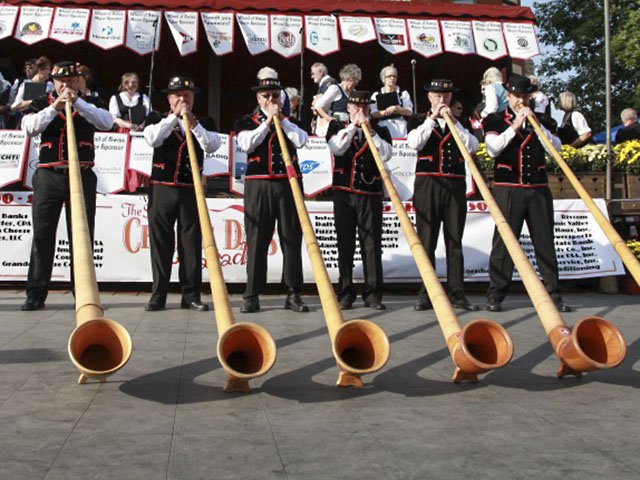
The alphorn is considered to be the national instrument of Switzerland. It was originally used by shepherds to call cows in for milking and also to call to other herdsmen and villagers. In the 1800s the alphorn started to fade from use due to cheese production transitioning from the Alps to the villages; in 1820, Niklaus von Mülinen began to repair old alphorns and give them to talented players. The alphorn is very difficult to play because it does not have any finger holes or valves, instead, players change pitch only with their mouth. The alphorn’s distinctive sound has the richness of a brass instrument and the softness of a woodwind. Similarly to the practice of yodeling, alphorns had more or less lost its original function in the mountain, however it still gained an audience. Nowadays, people enjoy the alphorn as a musical instrument rather than a shepherd’s tool.


Provide Feedback